

Hunting October Whitetails in the Appalachian Mountains
By Jon Cooper for Whitetail Times
Hunting the October bow season is one of my favorite times of the year. However, it’s also one of the most challenging—getting on mature bucks, getting them to daylight, and, furthermore, getting them within bow range. On our family property in Botetourt County, however, bow season isn’t all about chasing mature bucks. October is usually about three things for us: shooting does, punching our bear tag, and putting boots on the ground for sign. If we happen to get on a mature buck, we’ll hunt him.
Below is how my brother Matt and I break down and attack October. There may be a few constants involved in the varying dates below; however, the most important constant is access. If you’re spooking deer in and out of the stand in October, your chances of success drastically decrease. November is much more forgiving. Hunters can use terrain features such as ditches, hollows, and fringe access roads that set up well for getting into and out of the stand undetected. To put it simply—deer cannot know they’re being hunted.
Early October: 1-8
Goals
The switch for a buck’s range flips around September 5 once the velvet sheds. Sometimes bucks move ridges or properties, while others stay in the same general area as their summer home range. This phenomenon can be summed up only by saying bucks are individuals. Some are homebodies, while others are roamers. Past history with a buck usually foretells the future.
Bucks and does are usually still on their summer patterns when bow season opens. There is about a seven-day window to get on a buck if you know he’s daylighting in an area. In areas where managers have determined that does need to be removed off the landscape, the early season is a great chance to get some doe work out of the way. Afternoons over white oak acorns or food plots adjacent to bedding areas can certainly bring does within range. Managing doe numbers is work, but it can be fun. It’s also great practice for when a buck does present an opportunity. Setup and shot execution become muscle memory.
Another major goal for us during the early bow season is getting on black bears. If there are lots of bears like what’s been around our area for the last decade, finding bow stands isn’t hard, but this requires boots on the ground. My brother and I walk miles during late September and early October looking for acorns to find the latest bear sign to hang a stand on. This is usually a cluster of white oaks that hit in a two-acre area. White oaks are like candy bars to bears, and they return daily around the same time as long as they are available. On bumper crop acorn years, getting on a bear is more difficult. However, on years where sporadic white oaks hit, it’s usually pretty easy to find where bears are frequenting. Removing one of the deer’s biggest predators from the landscape is certainly an early-season goal for us, and they’re just plain fun to hunt.
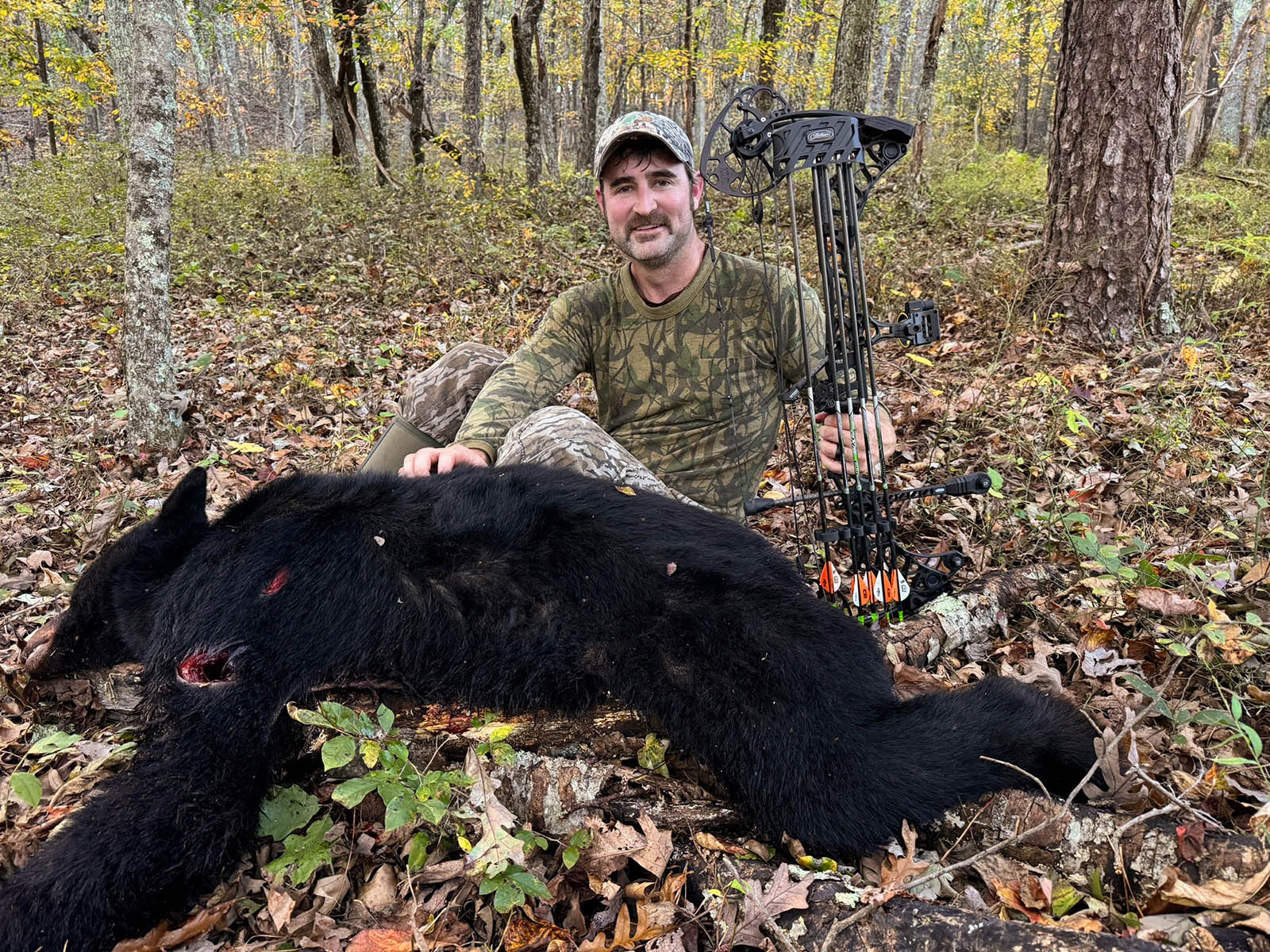
The author killed this black bear over white oak acorns. The first week of bow season is the best time to harvest a black bear. Once those acorns are gone, bears will move out of that specific area. The Rage 2 blade broadhead hit its mark. Photo courtesy of the author
Bed-to-Feed Pattern
Finding a mature buck in early October and getting him in daylight and within bow range is a tough task, but not entirely impossible. Bucks are still using their summer area in early October, and it’s all about bed to feed in the afternoon. I usually will not buck hunt October mornings until around the 25th. Busting deer in the hardwoods prior to daylight happens frequently, especially in and around food sources.
The afternoon, however, is a different story. If you know a buck is feeding on acorns or in a food plot, it’s one of the best times to harvest him. Those circumstances are rare. It usually involves a well-managed property that has a designated bedding area very close to a staging area or food plot. Bucks just aren’t going to get up much before dark and having that food source as close to the bedding area as possible is the best opportunity a hunter has.
During early October, bucks are starting to make sign, but don’t be fooled. Most all early-season sign, whether rubs or scrapes, is made at night. When I see early bow season sign, I don’t hunt it. I more make note of it for the coming pre-rut to know that a buck is in the area.
Most recent information (MRI) is what matters in the early bow season. Sure, a hunter has a chance to kill a good buck every single time out. But having the most recent information—pictures, sightings, etc.—improves slim odds.
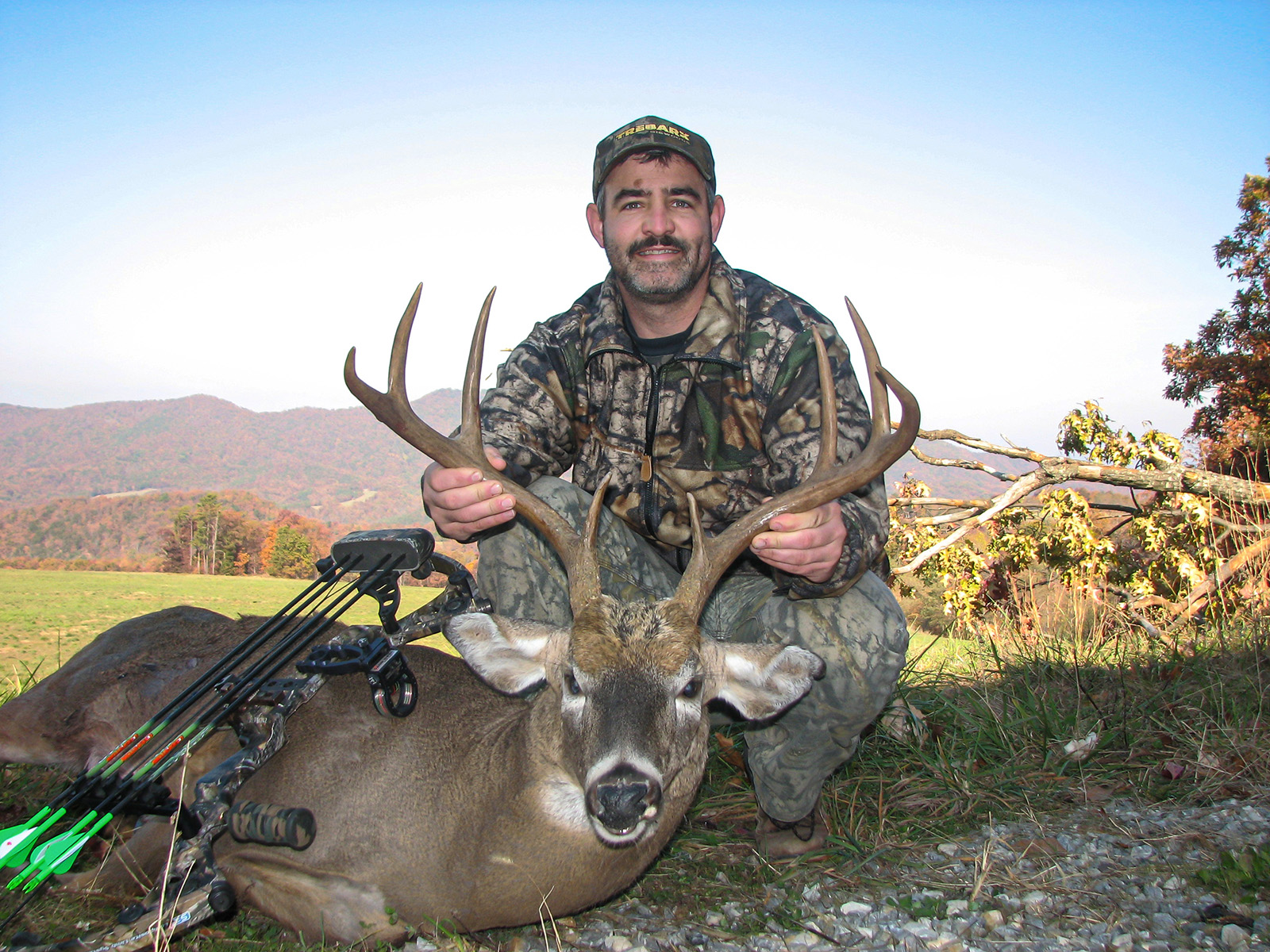
Pictured here is the author’s brother, Matt, with an outstanding Botetourt County whitetail taken on their family property. The brothers recognize the challenges that surround the early bow season. Their many years of experience provide a game plan for how they hunt October whitetails. Photo courtesy of the author
Putting it All Together
If I could pick one early October setup for a mature buck, it would be on a ridgetop in a staging area (some call them hidey-hole food plots) immediately adjacent to a bedding area. I want a ridge top where the wind stays steady at eight to 10 miles per hour, with my scent blowing over the hollow behind me. In our area with steep topography, it’s tough to gauge the wind regardless of the forecast. Once you add leaves on trees into the mix with terrain, it gets even tougher, as wind can often swirl. If you’re not sure what a wind direction does at a specific location, visit it multiple times prior to the season with different directions to find the optimum setup.
I want a bedding area that connects to a smaller staging food plot that eventually leads to a destination food source. This staging plot brings deer into bow range, and they may hit it prior to dark and before heading out into the larger feeding area. This one-acre staging area could be a well-managed clover plot to get deer within bow range on correct winds.
Mid-October: 9-20
Goals
The October Lull is widely debated, but from what we’ve seen, bucks are mostly nocturnal during these dates. Why? It could be for a number of reasons. I’ve always thought that hunters might put too much pressure on deer too early, pushing them nocturnal. A theory? Sure, but too much pressure and poor access can lead to a lull overnight.
Bucks are also starting to get motivated for the rut, and lots of sign is being made. This is the optimal time to get out and get boots on the ground. Community scrapes, which are used year after year, are opening up, and rubs are starting to really show. I want to be out there finding this new sign and making note of it for this season and future seasons.
During the middle of the month, my early season goals remain mostly intact. We’re still bowhunting for does to accomplish our management objectives. We’re still trying to fill our bear tag. However, now, I’m not buck hunting specifically as much unless I have MRI, but I’m adding more boots on the ground and checking known doe and family group bedding areas. Family groups—adult does and buck and doe fawns—use them year after year, and they vary a little bit annually with food.
For me, the best way to avoid an October Lull is to make sure I have really good access to stands that are on the fringe of core areas and only hunt them on the right winds.
If I think the percentages of shooting a mature buck drastically decrease, I want to cover as much ground as possible during this time while still accomplishing my management goals of shooting does and a bear.
Late October: 21-31
Goals
Hopefully, after early-to-mid October, hunters have meat in the freezer. It’s now time to turn our attention to target bucks. If the weather is warm, I keep putting boots on the ground in the mornings for November stands and bow hunting evenings. By this time, you may or may not have located a mature buck to hunt. My goal by late October is to have multiple stand sites hung for a target buck before (hopefully) a late October cold snap. I want to have multiple fringe stand locations for multiple wind directions.
Getting Ready
Around October 25 is usually the time to start hunting mornings, weather pending. If there’s a cold front that hits a couple days prior, however, I’ll hunt those mornings as long as my schedule permits and the wind works with stand locations.
As the rut gets closer, terrain features connecting doe and family group bedding areas can be a great location on late October mornings. Bucks will start to travel these features, checking does around this time. Terrain features between food sources and bedding areas can also play well. These are normal November rut stand locations between family groups or between food sources.
If hunters are going to target scrapes, the last week of October is the time. I don’t hunt over scrapes specifically; it’s more terrain features around a buck’s core area where sign is present. Often, scrapes are located in these terrain features that connect known family group bedding areas, such as saddles, funnels, flats, and benches.
Putting it All Together
Much like early October, I’d rather be in a staging plot immediately adjacent to a bedding area in the evening. The ideal setup is catching a daylighting buck coming out of a bedding area into the staging plot before heading out to the destination food source.
Since we’re now hunting colder mornings, I like terrain features between two feeding areas and/or doe and family group bedding areas, much like the height of the pre-rut in early November.
Jon Cooper manages his family’s recreational property in Botetourt County and has a passion for habitat management. Cooper serves on the Virginia Department of Wildlife Resources board and as a director with the Appalachian Habitat Association. Cooper was named the 2024 Deer Manager of the Year by the National Deer Association. He is passionate about his church, family, business, hunting, and helping landowners and managers see the benefits of high-quality native habitat.
Legal Disclaimer:
EIN Presswire provides this news content "as is" without warranty of any kind. We do not accept any responsibility or liability for the accuracy, content, images, videos, licenses, completeness, legality, or reliability of the information contained in this article. If you have any complaints or copyright issues related to this article, kindly contact the author above.
